Though paganism was eclipsed (chapter 6), the 'Christianity' which replaced it was equally abhorrent to God. In chapters 7, 8, and 9, the saints continued to spue out the apostacy and were persecuted throughout the Empire. Their cries brought God's wrath upon the Western Roman Empire in the form of the barbarian invasions, and the overthrow of its capital Rome in AD480, and upon the Eastern Roman Empire in the form of the Islamic invasions, followed by the four Turkish destroying angels, resulting in the overthrow of its capital Byzantium (Constantinople) in AD1453.
The symbolism of Revelation 7 depicted the opening events of the seventh seal, although it does not expressly say so. This will become clearer as we consider the symbolised events of chapter 8. Chapter 7 described the preaching of the Word of God during an era of toleration, the four Germanic invading wind-powers being restrained behind the borders of the Roman earth to allow this work. The Word of God was preached throughout the Roman Empire and that form of Christianity, adopted by the Emperor Constantine, was, at the same time, exposed as falsehood by these faithful preachers.
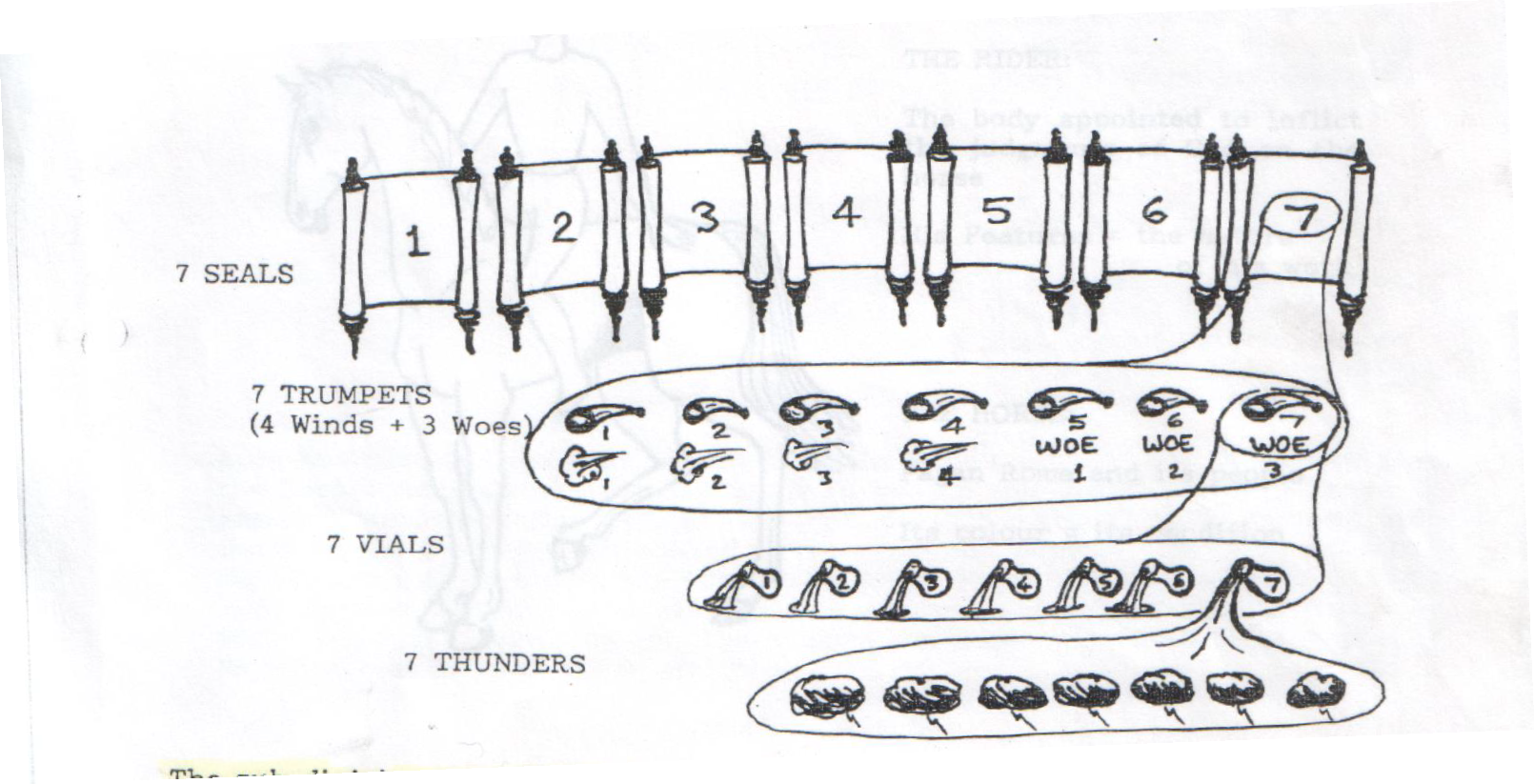
The Seven Seals and their subdivisions
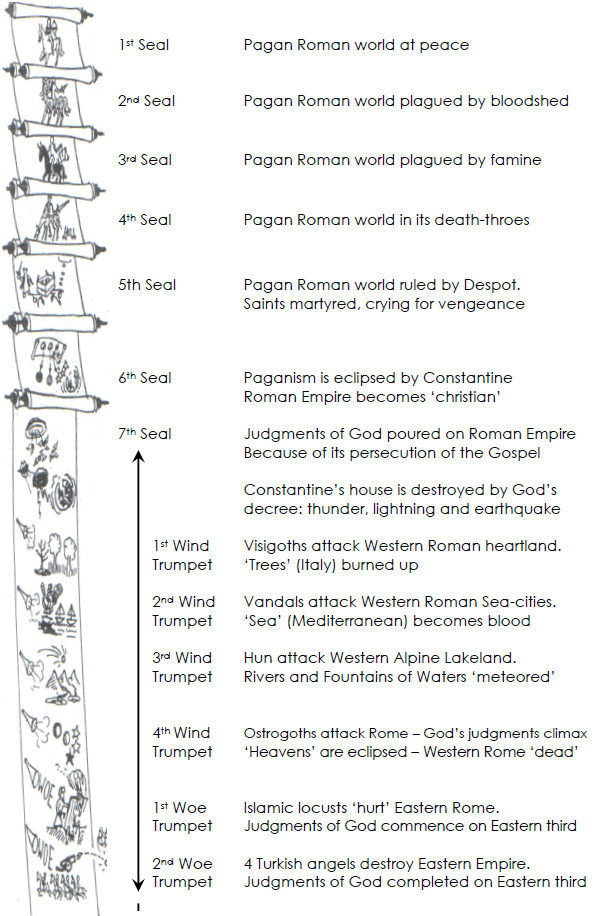
Summary of 7 Seals and 6 Trumpets
The period began with Constantine as sole Emperor over the Roman Empire, having converted it to so-called christianity. This moon-worshipping Emperor-god was, however, a fraud and his religion a lie. His adopted sign of the cross was but a disguise for his paganism, and became the sign of false-christianity. For just under 15 years, represented by ‘about the space of half an hour’ Emperor Constantine reigned over an Empire at peace, the Germanic invading ‘winds’ being restrained by divine decree (Revelation 7:1)Revelation 7:1XWaiting for response to allow God’s messengers to bring others to the Truth and to spue out Constantine’s falsehood. The historian Gibbon spoke of ‘the general peace which he (Constantine) maintained during the last 14 years of his reign….’ thus confirming that the period of Constantinian peace lasted for almost 15 years (i.e. about the space of ½ hour).
Their testimony was not welcomed, however, by an Emperor denounced as the promoter of falsehood. Constantine did not take kindly to being branded a liar, the seed of the serpent, by the Gospel preachers. He had also been angered by the success of these servants of the living God as they went about sealing the Gospel in the foreheads of their converts. On account of his anger, Constantine had embarked on a vicious persecution of the true Christians. They suffered much at his hands and, like the generation before them, they cried unto the holy and true despot to avenge their blood. Their prayers are well represented by the smoke from the incense altar drifting up to heaven.
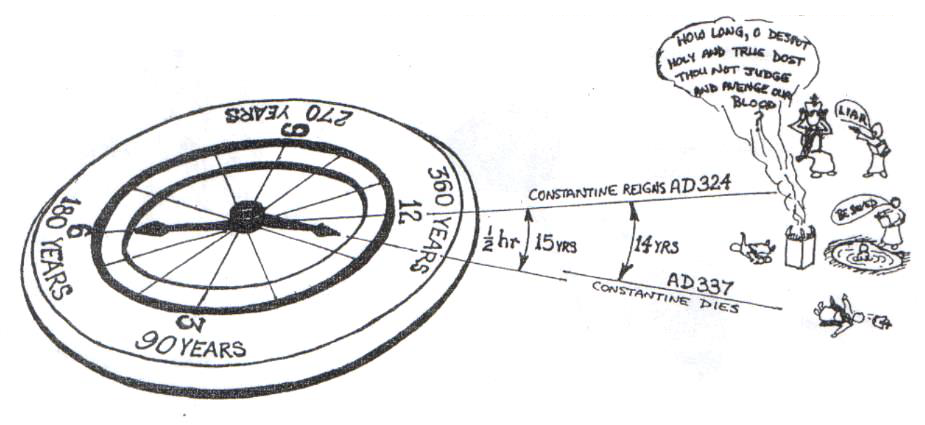
Silence in Heaven
In response to the cries of the saints, Jesus Anointed avenged the blood of another generation of the saints upon those who had been responsible for their persecution. The house of Constantine was appointed to experience the full weight of divine vengeance by means of voices (the divine decree pronouncing the death sentence), thunderings (international wars), lightnings (civil wars), and an earthquake (a shaking or upheaval of the whole constitution). The judgments of God were not only to be felt by Constantine, but by his whole household. Constantine, having made his three sons and two nephews (Dalmatius and Hannibalianus) Caesars under him, died in AD337. The soldiers, prompted by false rumours that Constantine had been poisoned by relatives, swore allegiance only to Constantine’s sons. A slaughter of other relatives followed – with two different nephews (Gallus and Julian) being spared. Constantine’s three sons then began to fall out over the sharing of that part of the Empire ruled over by Dalmatius and Hannibalianus, their murdered cousins. Thus began the lightnings and thunders and an earthquake.
The symbolism of the early verses of Revelation 8 depicted the period of peace during which the saints testified against the apostacy of the so-called christian Emperor Constantine. Being persecuted for their testimony, they cried unto God for vengeance. The peace came to an abrupt end with the death of Constantine in AD324, and the divine wrath which followed upon his household did not cease until AD363 when the last remaining ruler of his family was destroyed. The saints’ blood had been avenged. The earthquake which saw paganism briefly reinstated in Julian’s reign petered out and the Roman earth returned to its apostate christianity.
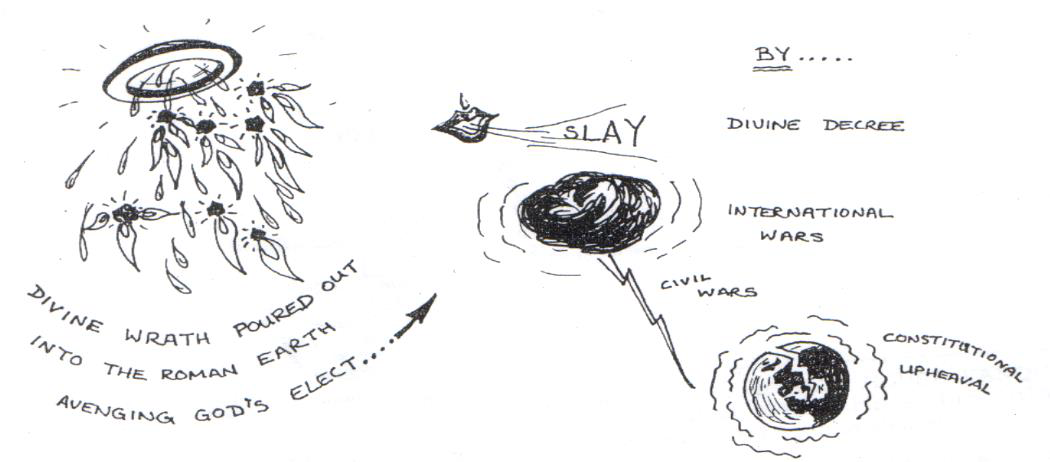
Fire from off the Altar
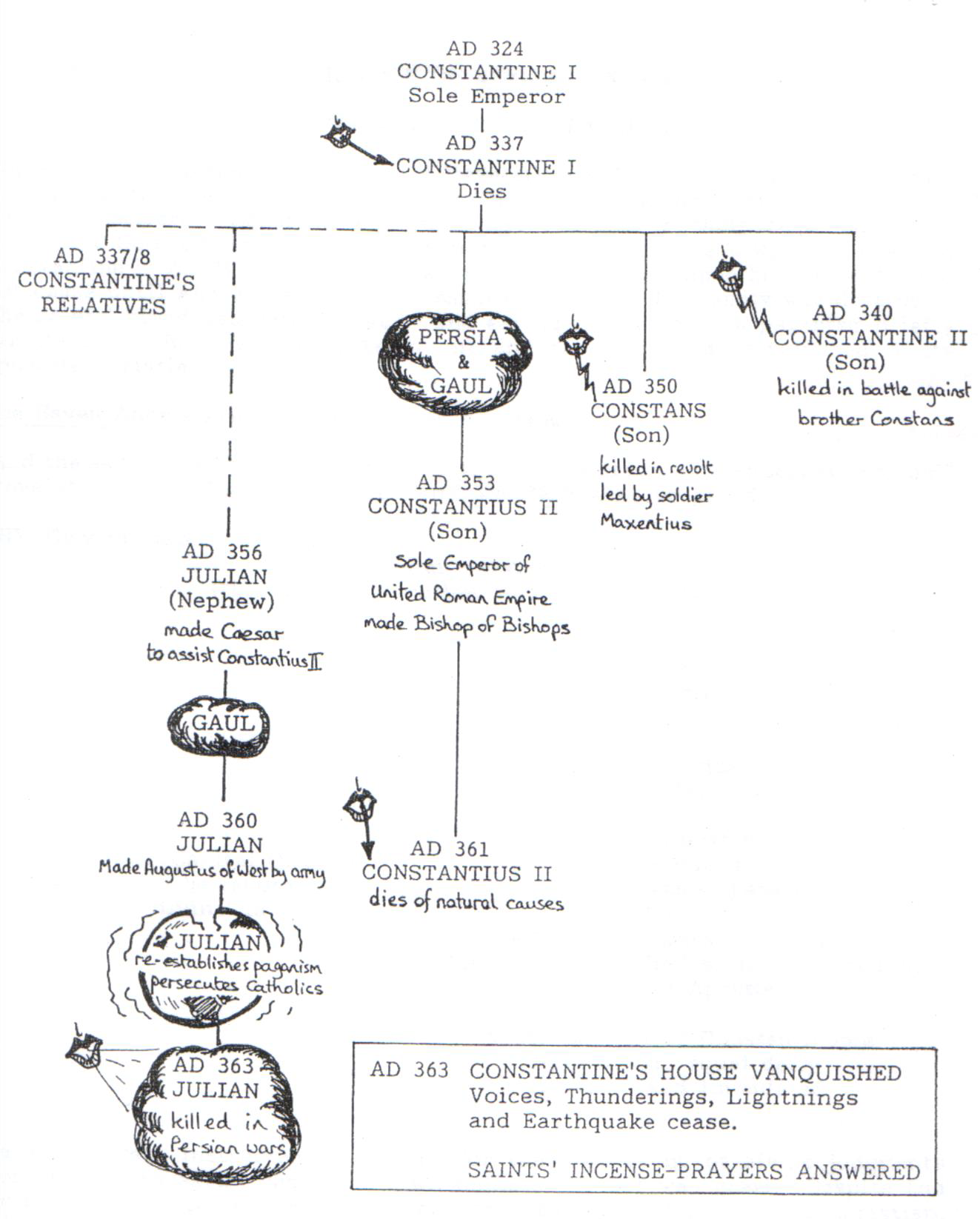
Voices, Thunderings, Lightnings and Earthquake
These angels were instructed to prepare for the outpouring of divine judgments upon the Roman earth, because the wickedness thereof was great. Despite the servants of God testifying to the fact that the catholic, so-called christian, religion was a blasphemous corruption, its popularity grew again with the death of Emperor Julian. Thus, whilst the judgments of God had been poured out upon the household of Constantine the apostacy was to become more vile and thereby increase the divine indignation. The angels were commanded therefore to prepare retribution to be inflicted at the appointed time, but the servants of the living God were still continuing their work of spuing out the lies.
God had appointed seven angels to pour out his judgments upon the Roman earth and had gathered four wind-powers (Revelation 7:1)Revelation 7:1XWaiting for response upon the borders of the Roman empire in order to inflict that retribution. Before these judgments could begin, however, it was necessary that the form of the Roman world be changed. The four Germanic wind-powers, having been restrained beyond the boundaries of the Empire by four angels, now had to be moved into position from where they could begin to inflict the retribution. The angels’ preparation work was to bring this about, a process which filled the years AD363 to AD395. Rome commenced the period as a united Empire ruled by one Emperor, and ended the period divided into three thirds (v.7Revelation 8:7XWaiting for response 'third part of trees') – the Western third, the Illyrian third and the Eastern third. The Germanic Visigoths (or Western Goths) dwelt in the Illyrian third.
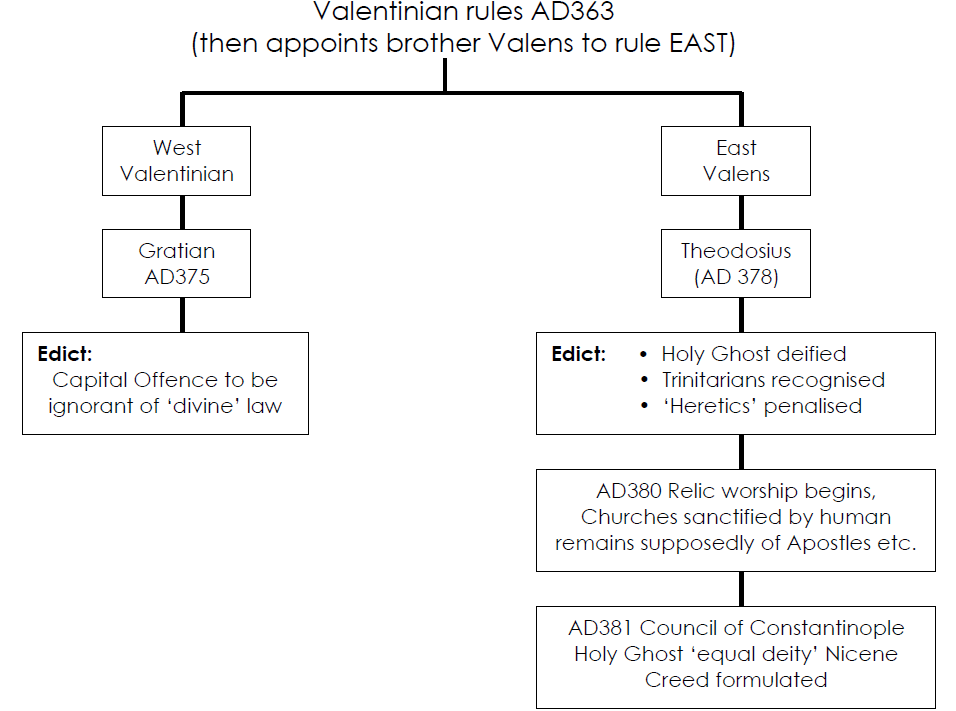
WHY they prepared
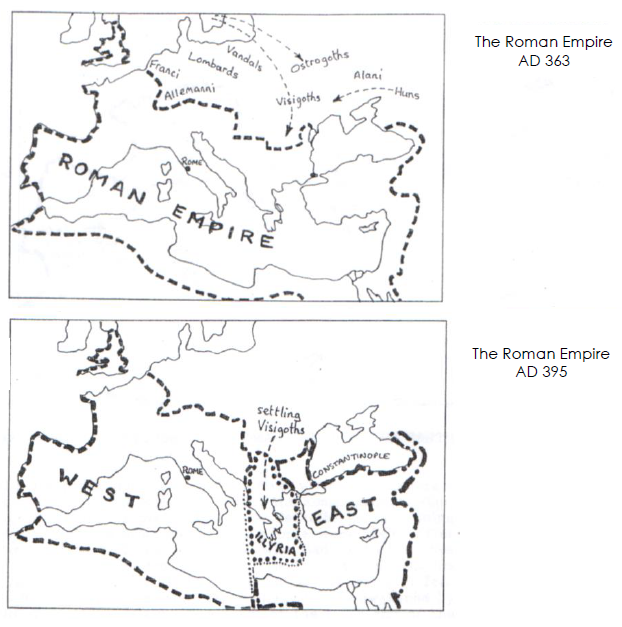
HOW they prepared
ALARIC AND THE VISIGOTHS INVADE THE WESTERN ROMAN THIRD OF THE EARTH
The first angel sounded his trumpet and unleashed the first wind. A confederacy of Germanic peoples began to ravage the Western third of the Roman Empire. Gaul (France) suffered particularly with 17 provinces – the Catholic grass – being devastated by fire. Many of the rulers, clergy and people were slain. After these preliminary battles, Alaric and the Visigoths, who had settled in the middle (Illyrian) third of the Roman Empire, invaded Rome three times. On the third occasion, Alaric laid siege against the city and, after six days, it fell. The gate of the city was breached and the inhabitants of Rome were awakened by the sound of the GOTHIC TRUMPET – AD410. The third of the trees and of the grass (i.e. the rulers and peoples of the Western third) were devastated by hail and fire mingled with blood and burnt up by fire. The retribution had begun!
Having seen that the symbolism of the early verses of Revelation 8 depicted the judgments of God on the family of Constantine, we then saw that, during that same period, the seven angels were transforming the Roman Empire from a single Empire into three divisions. The Empire was divided into East and West in order that the first of the Barbarian peoples could encamp in the midst of them, ready to pour out the judgments of God upon the Empire for its godlessness and murder. This preparation having been completed, one of the seven angels sounded the first trumpet and unleashed the first wind power – the Visigoths (or Western Goths) upon the Roman world. Seven angels were to sound forth their trumpets before the purpose of God was complete, the first four of which were to unleash wind-like powers of destruction. The Visigoths succeeded against Rome itself in AD410, and three more winds were soon to follow.
The Barbarians
The Germanic races of northern Europe were considered to be barbarians by the civilised world of the Roman Empire. These peoples were very fierce nomadic groups. Their migrations across Europe are well documented in history books & became known as ‘the Volkerwanderung’ – the people-wanderings. This amazing and timely movement of large numbers of peoples, promoted by the divine purpose, responded to the trumpet blast calling them to the battle. The angels at the boundaries of the Empire opened the doors and allowed these divine agencies to enter into the heart of the apostate Empire.
The land of the Empire
Having considered the first trumpet, and having seen how Alaric and the Visigoths burned up the Western third of the Empire, symbolised by the trees of the third being burned up and the grass thereof, it is beneficial to pause for a moment to reflect on the make-up of the Roman Empire. Italy, and Rome in particular, was the heart of the Empire and appropriately symbolised by ‘the earth’ – its peoples by ‘trees’.
To the north of Italy lay the Alpine Lakeland, formed by the migration of many rivers through the Alps en route to the sea and clustered to the north of Italy. This Alpine Lakeland was bordered on the north by the river Danube.
Along the south of the European Empire of Rome lay the natural boundary of the Mediterranean Sea – that sea which had been notable in casting up the four beasts of Daniel’s vision (Daniel chapter 7). The Great Sea, as it was sometimes called, was the arena of their destructive work, and was to become the arena again in this era of the world’s history.
Thus in considering the prophetic vision and its symbols it is helpful to keep in mind the description of the Roman Empire centred on ‘the (Roman) earth’ of Italy, bordered to the north by the ‘rivers and fountains of waters’ and to the south by ‘the Sea’. These symbols will be significant in our consideration of the sounding of the first four wind-trumpets, and to the pouring out of the vials, later in Revelation.
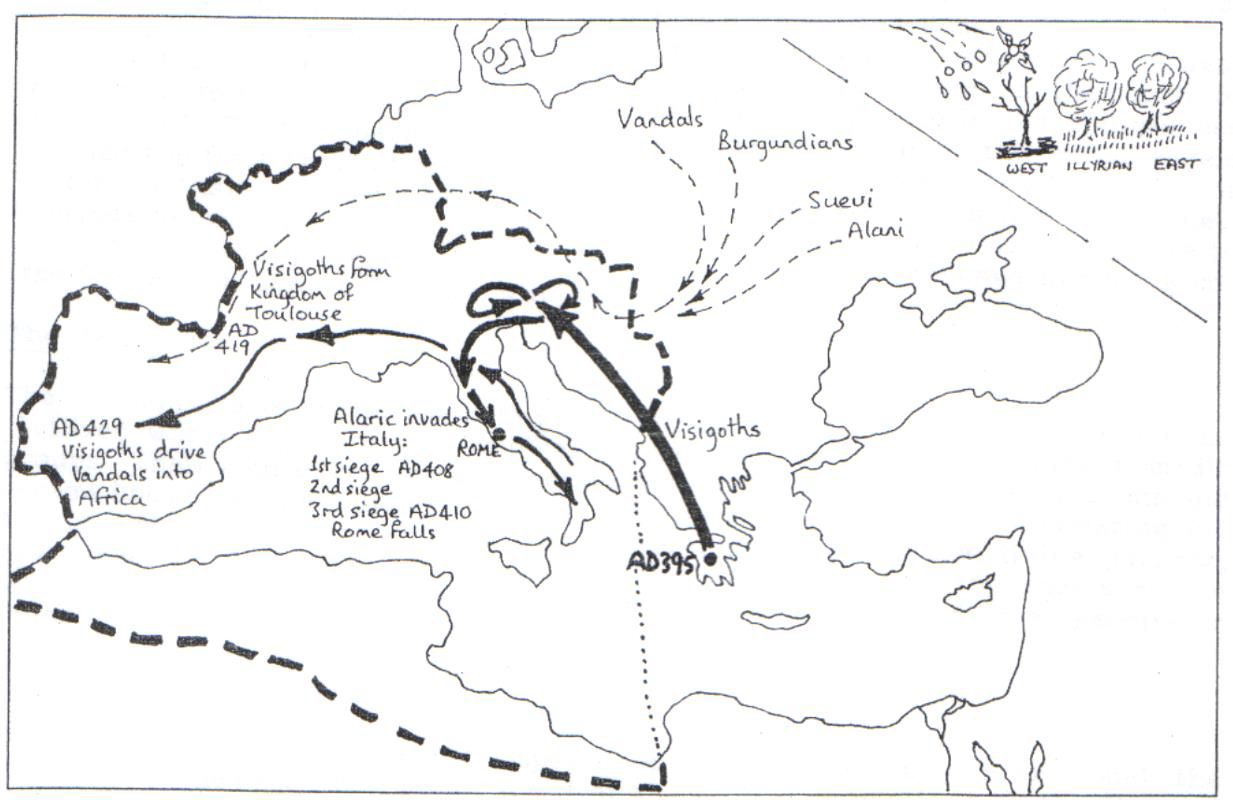
ALARIC AND THE VISIGOTHS INVADE THE WESTERN ROMAN THIRD OF THE EARTH
GENSERIC AND THE VANDALS VANDALISE THE WESTERN THIRD OF ROMAN EMPIRE
The second angel sounded his trumpet and unleashed the second wind. The Germanic Vandal peoples, led by Genseric, moved from Spain and conquered Northern Africa, bringing peace to the faithful Christians. Genseric ravaged Carthage, the Empire’s grainstores, cutting off its supplies. There he formed a navy to make annual excursions against the Roman Empire’s Mediterranean sea ports, selected at random to be ‘vandalised’. Rome was plundered for 14 days in AD455. A navy of 300 large galleys was built to counter the Vandals but Genseric destroyed it in the Bay of Carthagena before it had set sail. At Zante, 500 of the nobility were captured, mutilated and cast into the sea. The combined navies of Italy and Constantinople (1113 ships and 100,000 men in total) sailed against him. As they anchored off Carthage, Genseric used the WIND to blow countless fire rafts amongst the ships, setting them alight with great loss of life. The Vandal ‘mountain’ fire-bombed the navy of the Western Roman third, and many of its ‘fish’ (men) died in the sea. In AD477 Genseric died and the wind ceased, but the Trinitarian West had been severely punished for their treatment of God’s elect, whose prayers had thus been answered.
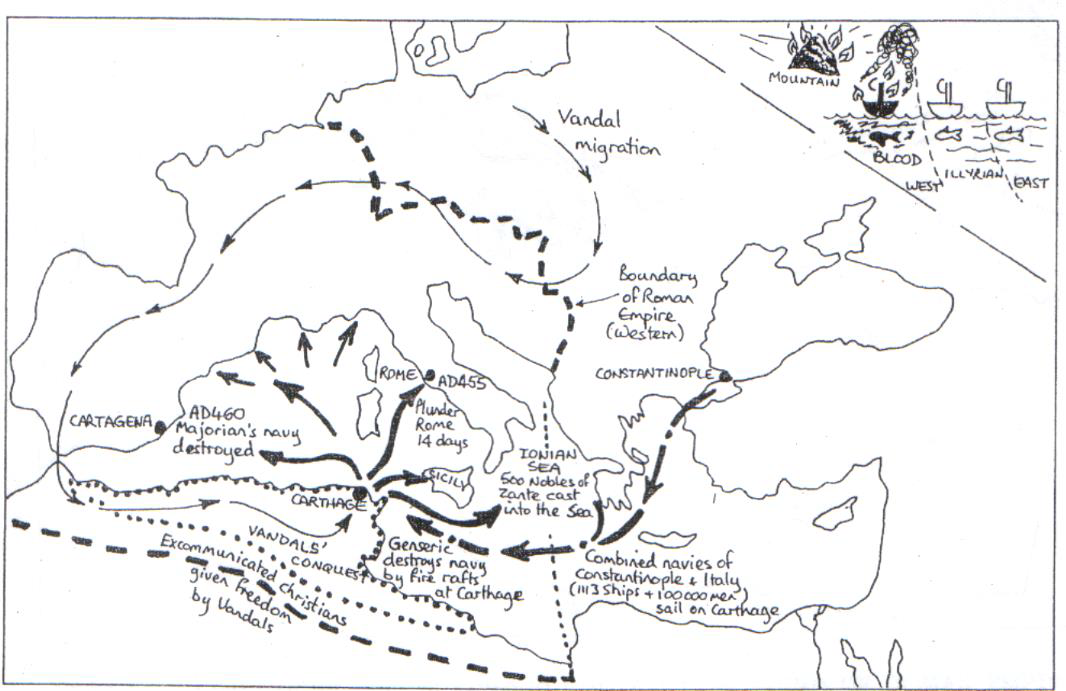
GENSERIC AND THE VANDALS VANDALISE THE WESTERN THIRD OF ROMAN EMPIRE
After a 5-year war between Attila the Huns and the Eastern Emperor Theodosius, peace was finally declared. The Huns were given the central Empire, and settled around the river Apsinth. From there Attila and the Huns launched out of the Apsinthian (Wormwood) region on the death of Theodosius, in AD450, and blazed a trail of destruction along the path of the River Danube, devastating the cities of Gaul and killing "many of the men" - namely between 160,000 and 300,000 men. Attila then crossed into the region of the rivers and fountains of waters, and into northern Italy. There he ravaged the cities of the Alpine Lakeland. Aquileia was left almost unfindable. Altinum, Concordia and Padua were reduced to stones and ashes. Vicenza, Verona and Bergamo were cruelly scourged. Milan and Pavia submitted, and suffered little. The Venetians fled to the small islands off the coast and formed VENICE. The Western Third of the Empire was on its knees, and paid an enormous ransom to him. Attila returned to his capital in AD452, where he died suddenly in AD453. The shooting star had blazed a brilliant trail but had rapidly fizzled out.
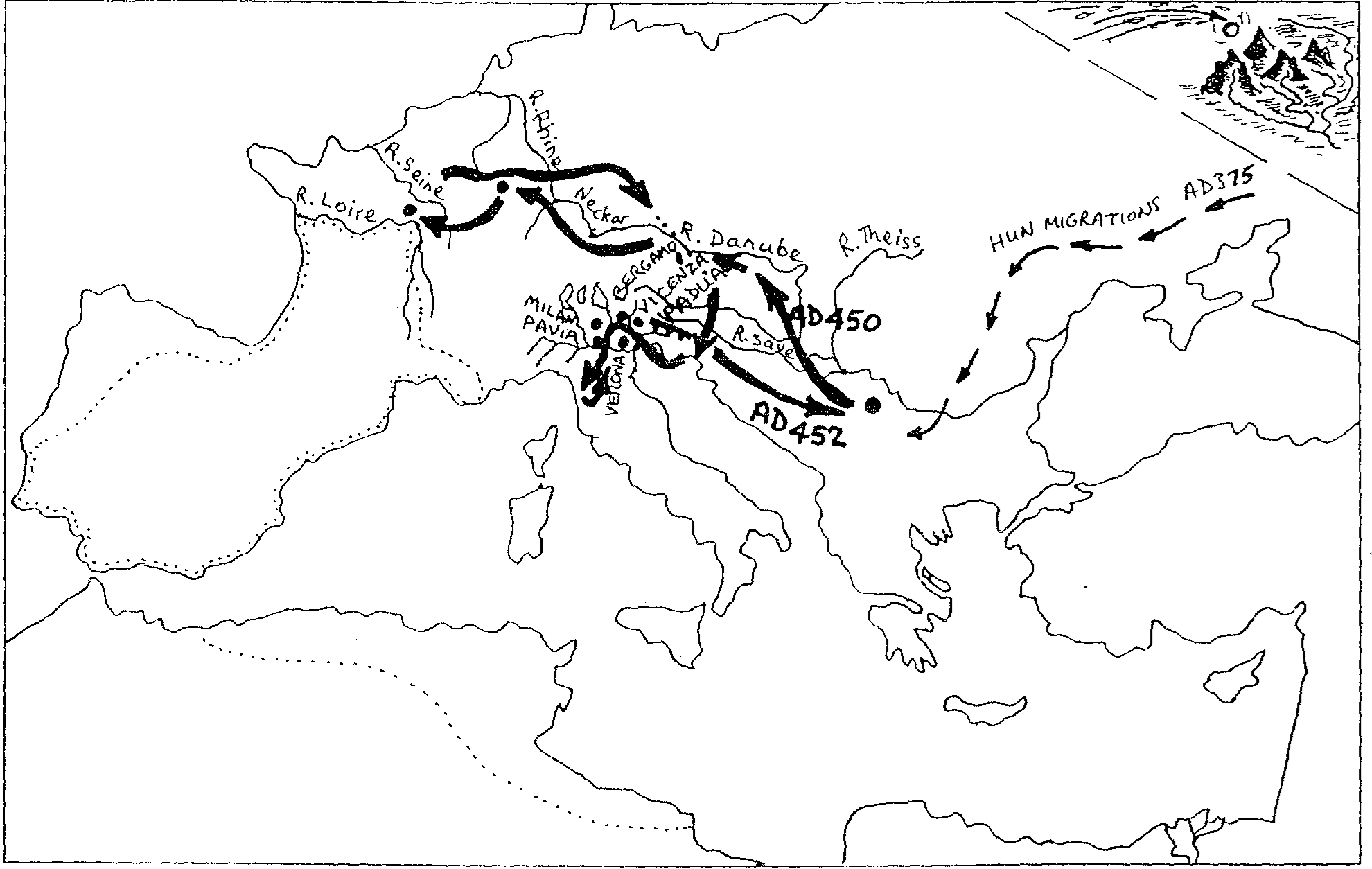
ATTILA AND THE HUNS SHOOT ACROSS THE WESTERN THIRD OF ROMAN EMPIRE
In AD475 Romulus Augustulus was made Emperor of the West by his father Orestes. The Barbarians began to demand that Italy should be divided amongst them. Orestes refused such demands provoking a revolt. The soldiers turned to Odoacer the Barbarian, and Orestes fled to Pavia. Odoacer stormed the city and executed Orestes. Odoacer deposed Romulus Augustulus and decreed: "The Throne of the Universal Empire shall be transferred from Rome to Constantinople" – eclipsing the imperial sun. Odoacer clamped down on Trinitarian Catholicism, eclipsing the ecclesiastical moon. In AD49I Theodoric the Ostrogoth rose to power in the Illyrian (central) third of the Empire, marched 700 miles to the Alps and engaged in a great battle with Odoacer at Ravenna. In AD493 Odoacer was assassinated and the fall of the governmental stars completed the eclipse of the Western Roman Empire. WESTERN ROME WAS ECLIPSED - an eclipse lasting for a third of a day (1/3 x 360) and a third of a night (1/3 x 360), or 240 years.
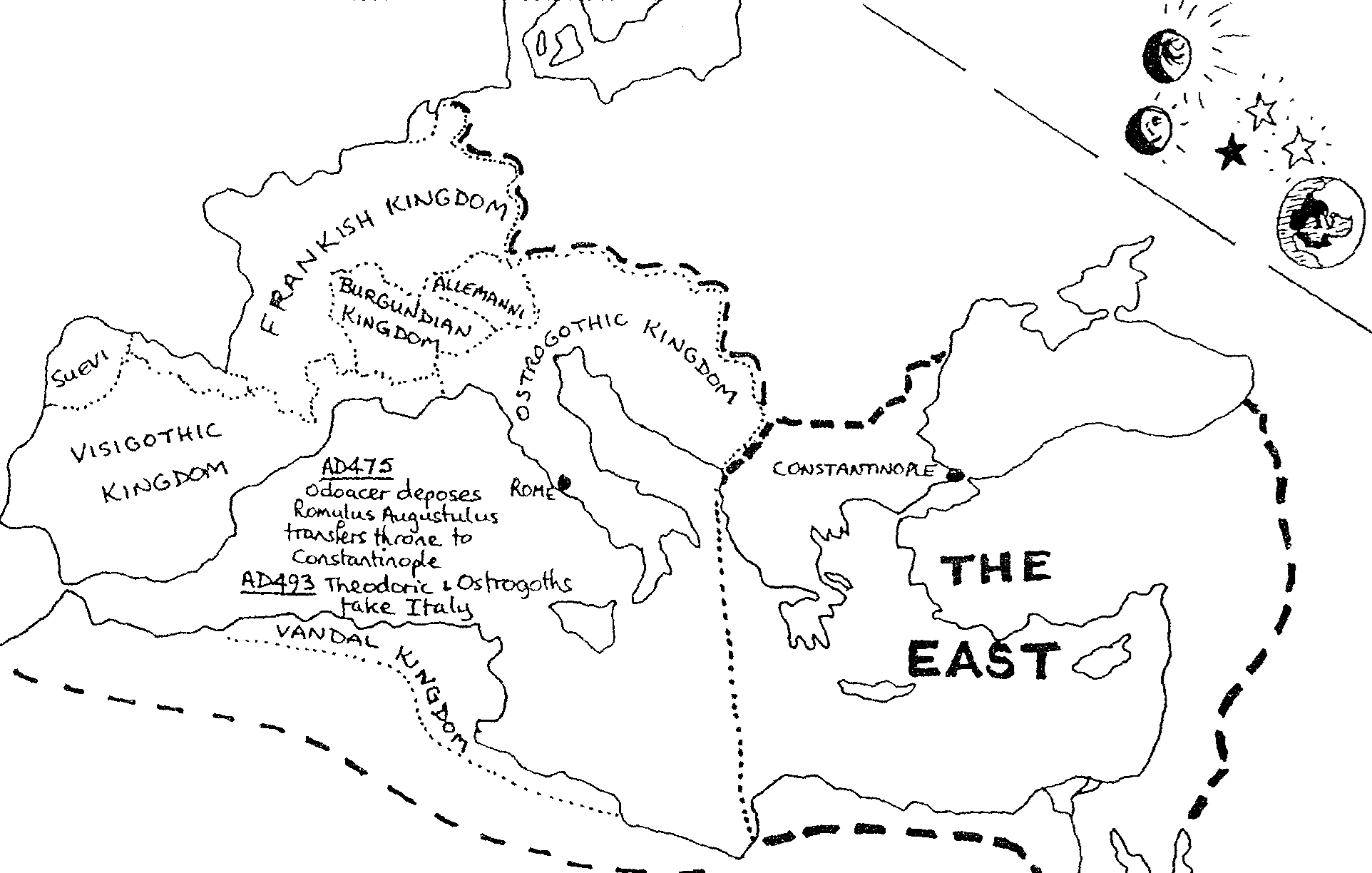
THEODORIC AND OSTROGOTHS ECLIPSE THE WESTERN THIRD OF ROMAN EMPIRE
There are 7 seals Revelation 5:1,5Revelation 5:1,5XWaiting for response where the opening of each one reveals elements of a time period.
This chapter contains the opening of the seventh seal which is different to the others as it contains the seven trumpets, each with their own prophecy for a time period Revelation 8:1-2.Revelation 8:1-2XWaiting for response