In this chapter, the Spirit reveals those events which would occur in the pagan Roman Empire in which the saints were valiantly preaching that men should repent of their paganism and turn to God. The result was that they were persecuted by an offended Rome which, through a sequence of civil wars, was punished by God and paganism was finally eclipsed - avenging the blood of His saints.
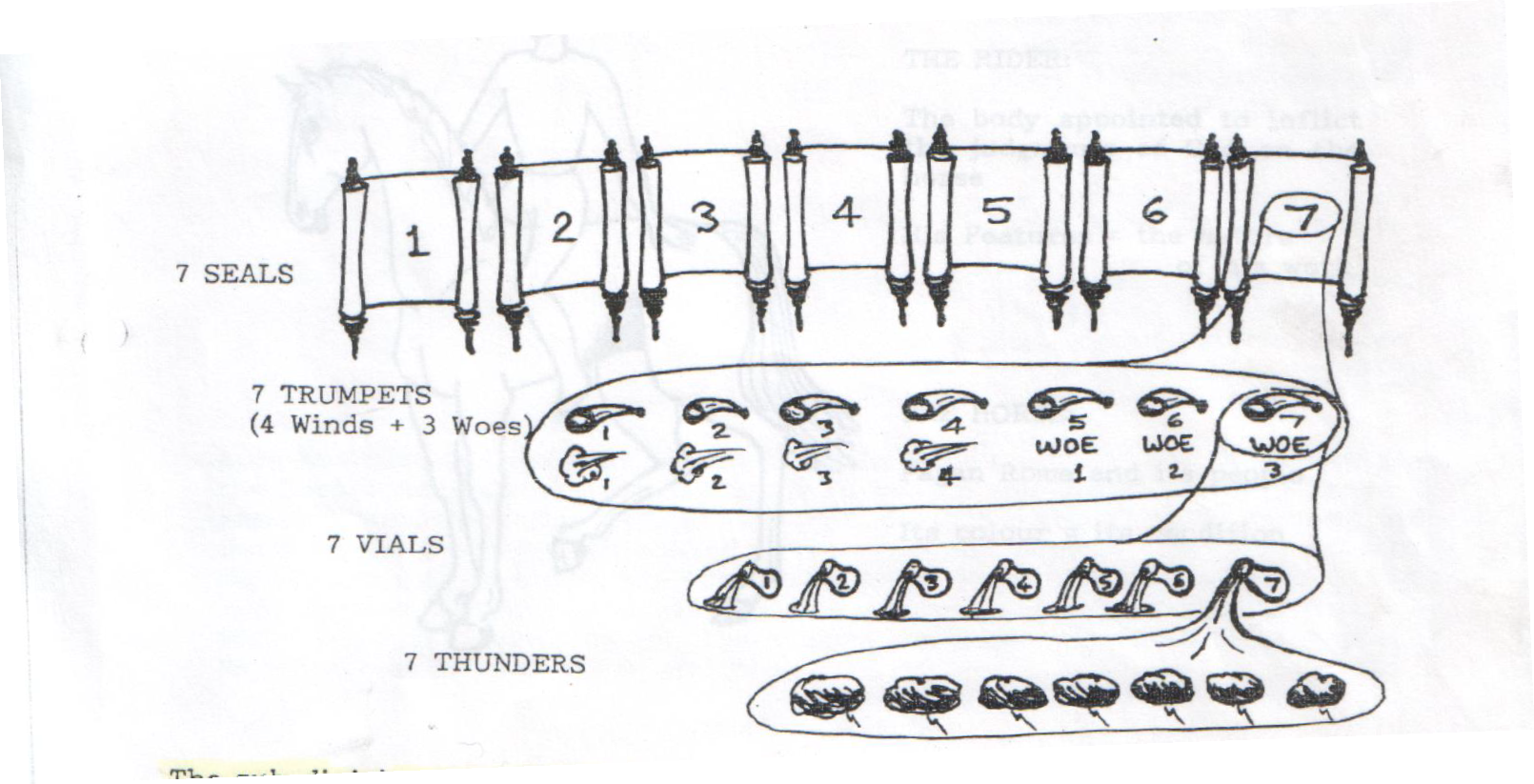
The seven seals and their subdivisions
In the course of the six seals, from AD96 to AD324, the Gospel messengers preached and suffered at the hands of the pagans for their preaching. Their persecutors in each seal became the people punished in the following seal, as their Lord answered their prayers for vengeance.
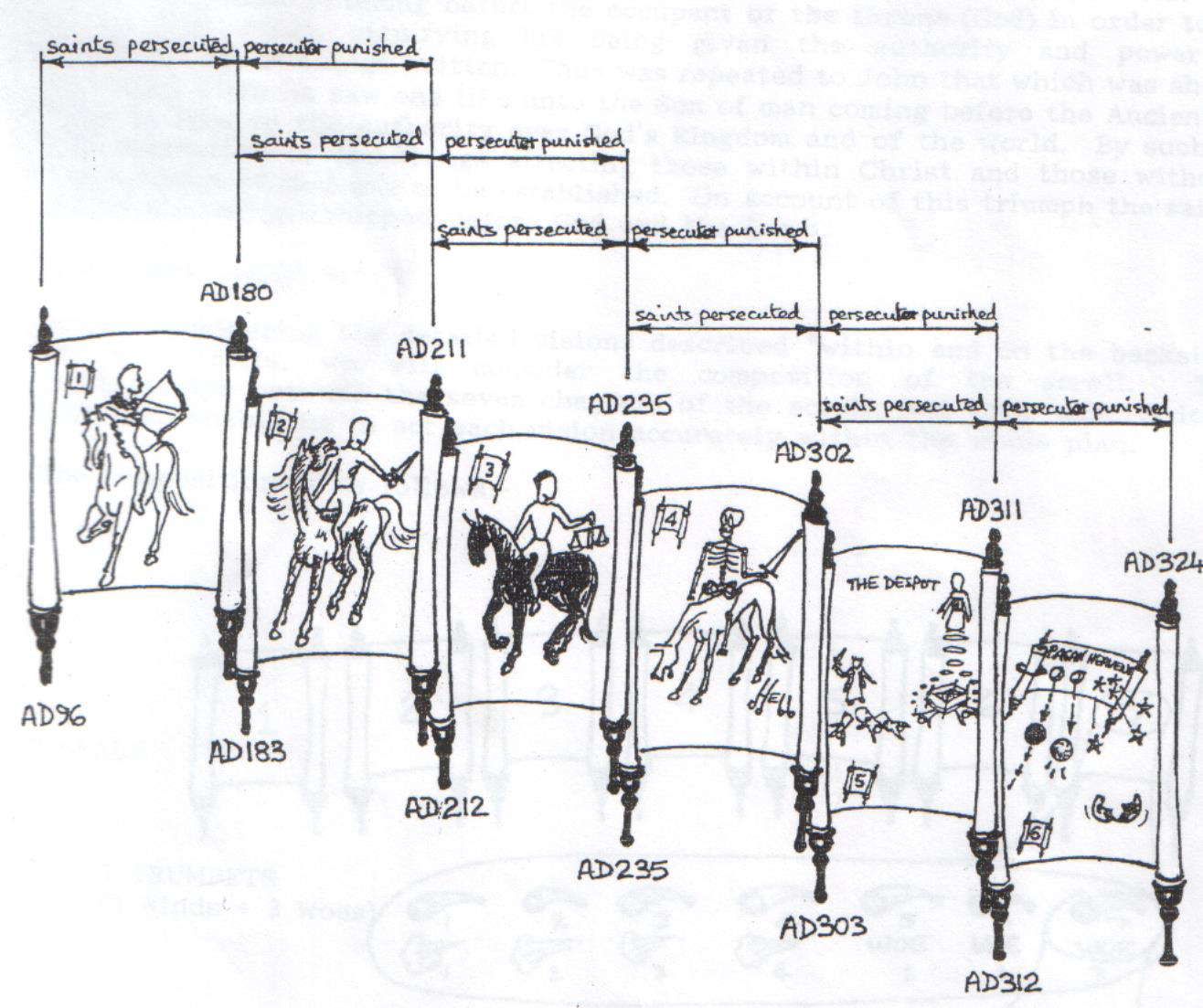
Revelation 6 - Rome Under the Pagans
The first four seals share some similarities v.1,3,5,7.Revelation 6:1,3,5,7XWaiting for response They each:
- were heralded by one of the four beasts
- contained a horse of distinctive colour
- depicted a rider having certain distinctive characteristics
The general representation is:
- The proclamation - A startling event alerting the faithful that the next seal was about to begin - ‘Come and behold…’
- The rider - The body appointed to inflict the judgments of God on the horse - His features = the nature of his work
- The horse - Pagan Rome and its people - Its colour = its condition
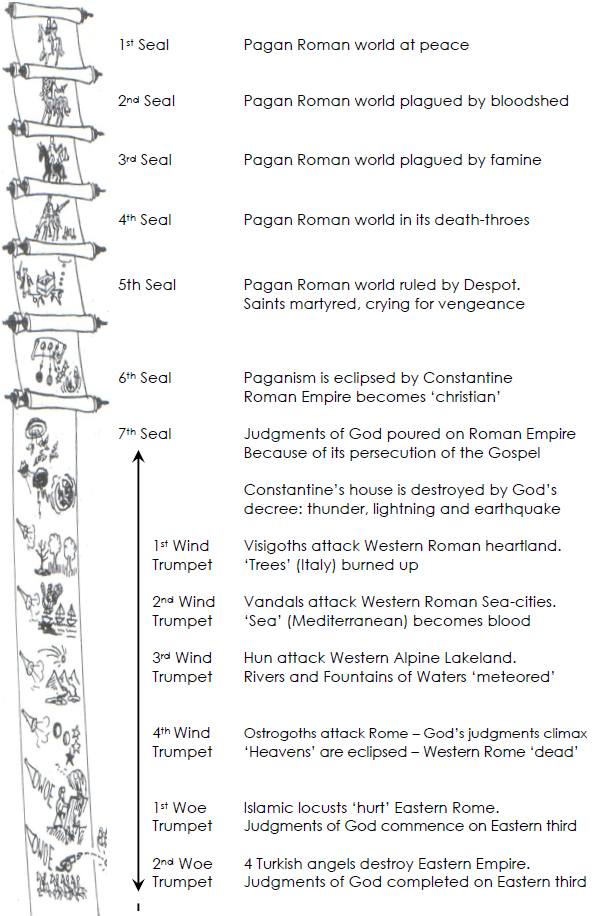
Summary of 7 Seals and 6 Trumpets
AD96 to AD180 was the most peaceful time in Rome’s history, and that peace gave the Gospel messengers the opportunity to preach the Gospel to the pagans. In Rome’s peace, the saints were at war with paganism, though their weapons were the Word not the sword, symbolised by the arrowless bowman. Thus they exerted a significant influence over the people (horse) of pagan Rome. They were to fight many battles before they would win the war, going forth conquering that they might conquer. Nevertheless, the victory belonged ultimately to the saints. Paganism was to be dealt a fatal blow.
THUNDERBOLT DECLARATION = Murder of Emperor Domitian (End of tyrannical rule)
CROWN = The victors laurels i.e. rider is final victor - ‘Conquering and to conquer’ is winning many battles on the way to winning the war
ARROWLESS BOWMAN = Gospel messengers 2 Corinthians 10:42 Corinthians 10:4XWaiting for response
HORSE = Pagan Rome and its people
White = The Roman people in peace (though not the saints) - Rome’s most peaceful period in its history AD96 to AD180
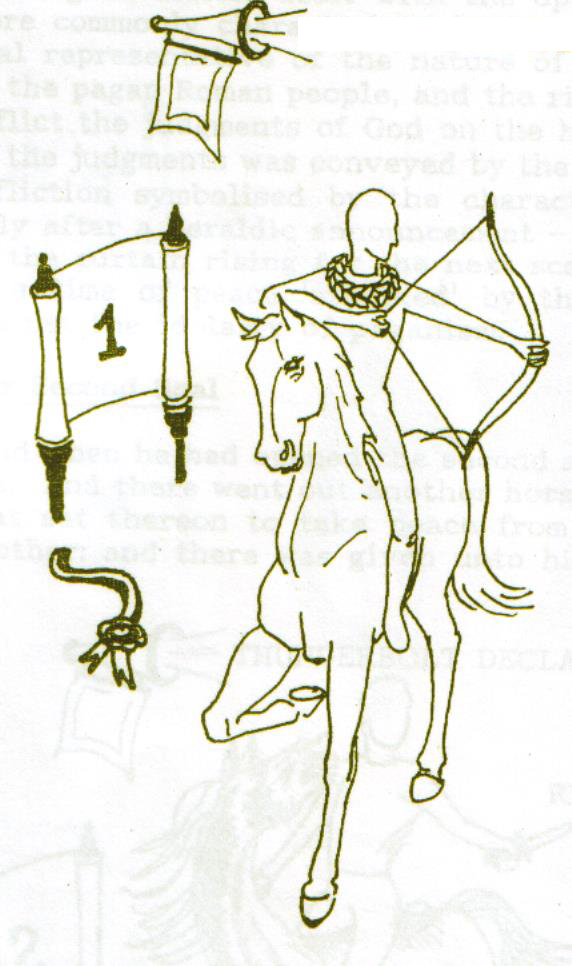
The first seal
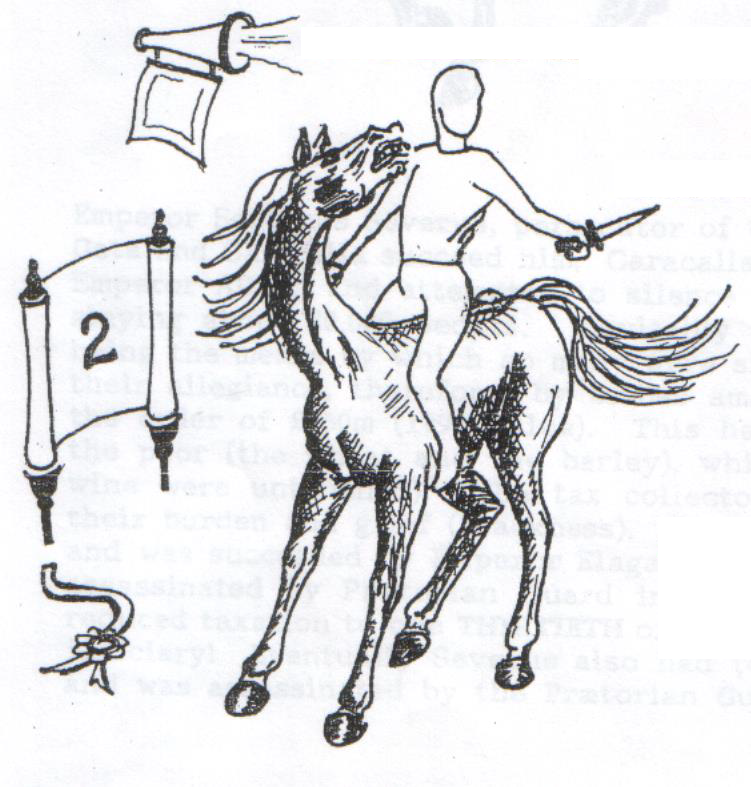
After the assassination attempt on him, Commodus distrusted the Senate and the nobility of Rome, and sought their blood in revenge. This sparked off a period of ceaseless blood-shedding, with Emperors, Praetorian Guard, Senators and nobility falling victims. These were the very people that had shed the blood of the saints, and God avenged their blood by this process. Pagan Rome was painted red by the dirk-wielders, being bathed in blood – AD180 to AD211.
THUNDERBOLT DECLARATION = Attempted assassination of Emperor Commodus by Senate
RIDER WITH DAGGER = Emperor and Praetorian Guard - Dirk (or dagger) = symbol of those with power over life and death:
1. Roman Emperor
2. Praetorian Guard
3. Assassin
HORSE = Pagan Rome and its people
Red = The Roman people bathed in blood. The peace (of the white horse period) taken from the (Roman) earth AD180 to AD211
The second seal
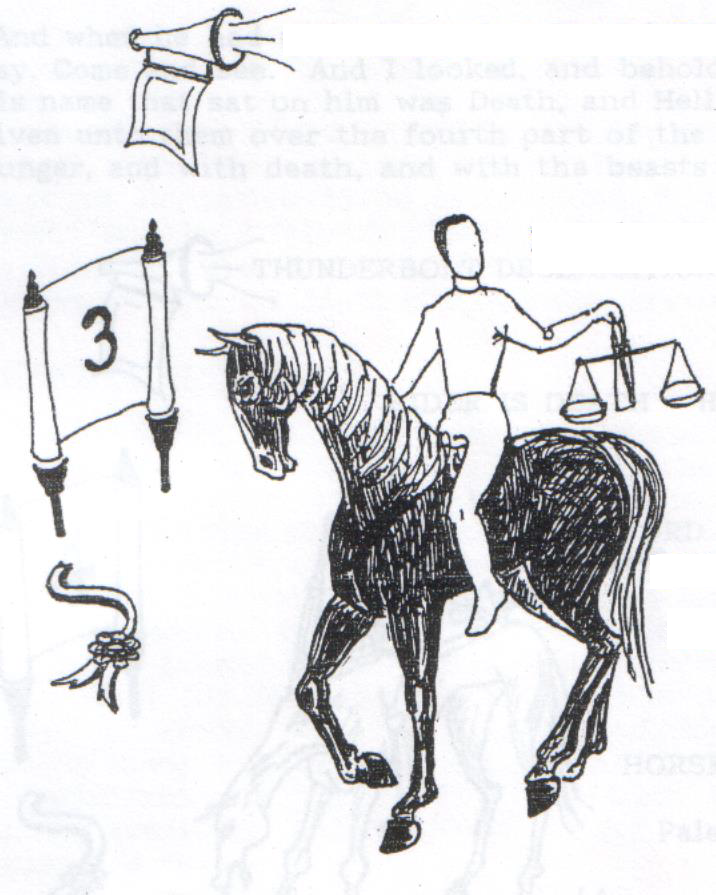
Emperor Septimus Severus, persecutor of the Christians, died AD211 and his sons Geta and Caracalla succeeded him. Caracalla secretly murdered Geta to become sole Emperor AD212 and attempted to silence all who might know his guilty secret, slaying about 20,000 people. Inevitably the Praetorian Guard knew his secret, being the means by which so many were silenced. Caracalla could only maintain their allegiance, therefore, by bribes amounting to an annual gift to them in the order of £150m (1993 value). This had to be paid for by high taxation of the poor (the wheat and the barley), whilst the rich escaped (the oil and the wine were untouched). The tax collectors also extorted the poor, adding to their burden and grief (blackness). Caracalla was finally assassinated in AD217 and was succeeded by Emperor Elagabalus, who continued taxation of the poor until assassinated by the Praetorian Guard in AD222. Emperor Alexander Severus then reduced taxation to one THIRTIETH of the level and sought to establish an honest judiciary! Eventually Severus also had to increase the level of taxation again and was assassinated by the Praetorian Guard during the unrest that followed.
THUNDERBOLT DECLARATION = Murder of Geta, joint heir of Emperor Septimus Severus, by his brother Caracalla
RIDER WITH BALANCES = Administrators of justice and law - Again represented Roman Emperor and Praetorian Guard who were executors of the law
HORSE = Pagan Rome and its people
Black = The Roman people afflicted by heavy taxation on basic foodstuff, bringing mourning and lamentation. The oil and wine of the rich was not touched by the tax – AD212 to AD235
The third seal
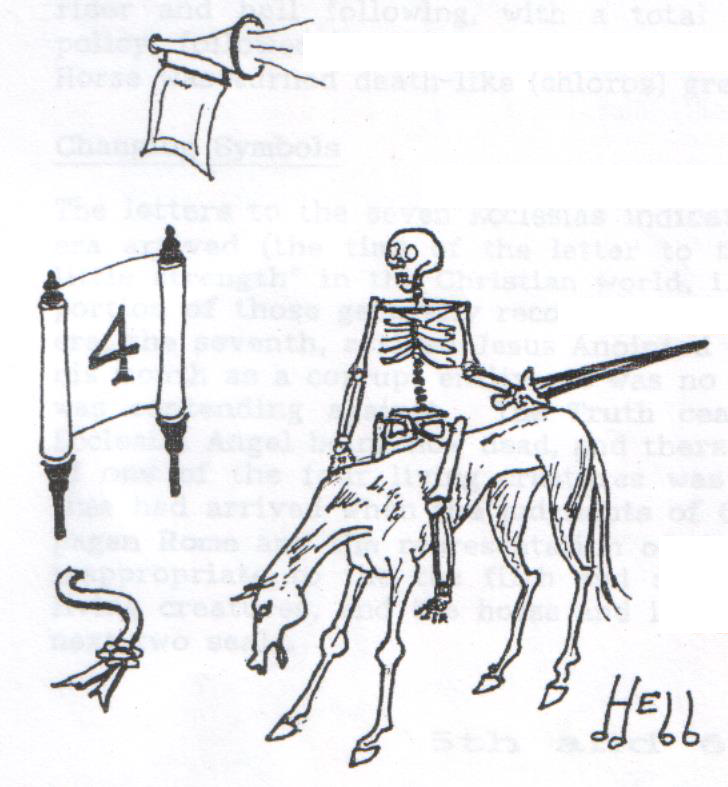
Maximin, a Thracean peasant of incredible strength, became the hero of Rome’s Rhine Army and was acclaimed Emperor by them, although Alexander Severus was already Emperor. Severus was therefore assassinated in AD235, and Maximin became Emperor of Rome – the opening of the fourth seal was thus heralded. Being a peasant, Maximin was despised by the nobility leading him to blacklist many of them and send them to the camps on the Rhine or Danube to be tortured and punished. This led to civil unrest, and Maximin’s own assassination in AD238. A constant turnover of Emperors followed as 39 died (35-36 assassinated) within the space of 70 years. Election to Emperor was like being elected to death – thus the symbol of death used to depict the Imperial rider of the pagan horse. With this ever-changing government no consistent policy could emerge. The Empire stagnated, agriculture declined, famine spread and disease resulted. The plague spread such that, at its height (AD250 – 265), it killed 5,000 people per day. Amongst Rome’s four Praefectures, it was the fourth Praefecture (i.e. ‘the fourth part of the earth’) which suffered most from the civil war (sword) and famine (hunger).
THUNDERBOLT DECLARATION = Assassination of Alexander Severus
RIDER IS DEATH AND HELL = Election to Emperor was election to death – 39 Emperors in 70 years
THE SWORD = Thracean sword by which 1st peasant-Emperor sparked off killing of those in fourth Praefecture of the Roman pagan earth.
HORSE = Pagan Rome and its people
Pale = Chloros/Green – indicating last stages of dissolution and impending death. The horse was rapidly dying AD235 to AD302
The fourth seal
The 5th and 6th seals were different to the first 4 seals in that they were not proclaimed by one of the 4 living creatures (or beasts) and there was no horse. It is suggested that the living creatures (who represented the saints Revelation 4:6-7)Revelation 4:6-7XWaiting for response were no longer included as part of the vision to indicate the state at which Christianity was at this point - it was getting further and further away from the truth and from God so there was no symbolic messenger from God. At this stage, the judgments of God were no longer restricted to pagan Rome, and so the horses (which represented Pagan Rome and its people) were no longer included.
5th and 6th seal symbol change & reason:
NO MORE HORSES = JUDGMENTS NO LONGER RESTRICTED TO PAGAN ROME
NO LIVING ONES (BEASTS) = NO COMMUNITY HOLDING THE TRUTH
It must be remembered that the object of the first four seals was to pour out the judgments of God on paganism, NOT to convert Rome to Christianity. The fifth Seal describes those changes which were taking place in Rome generally and the effect that events had on the small remnant of true believers.
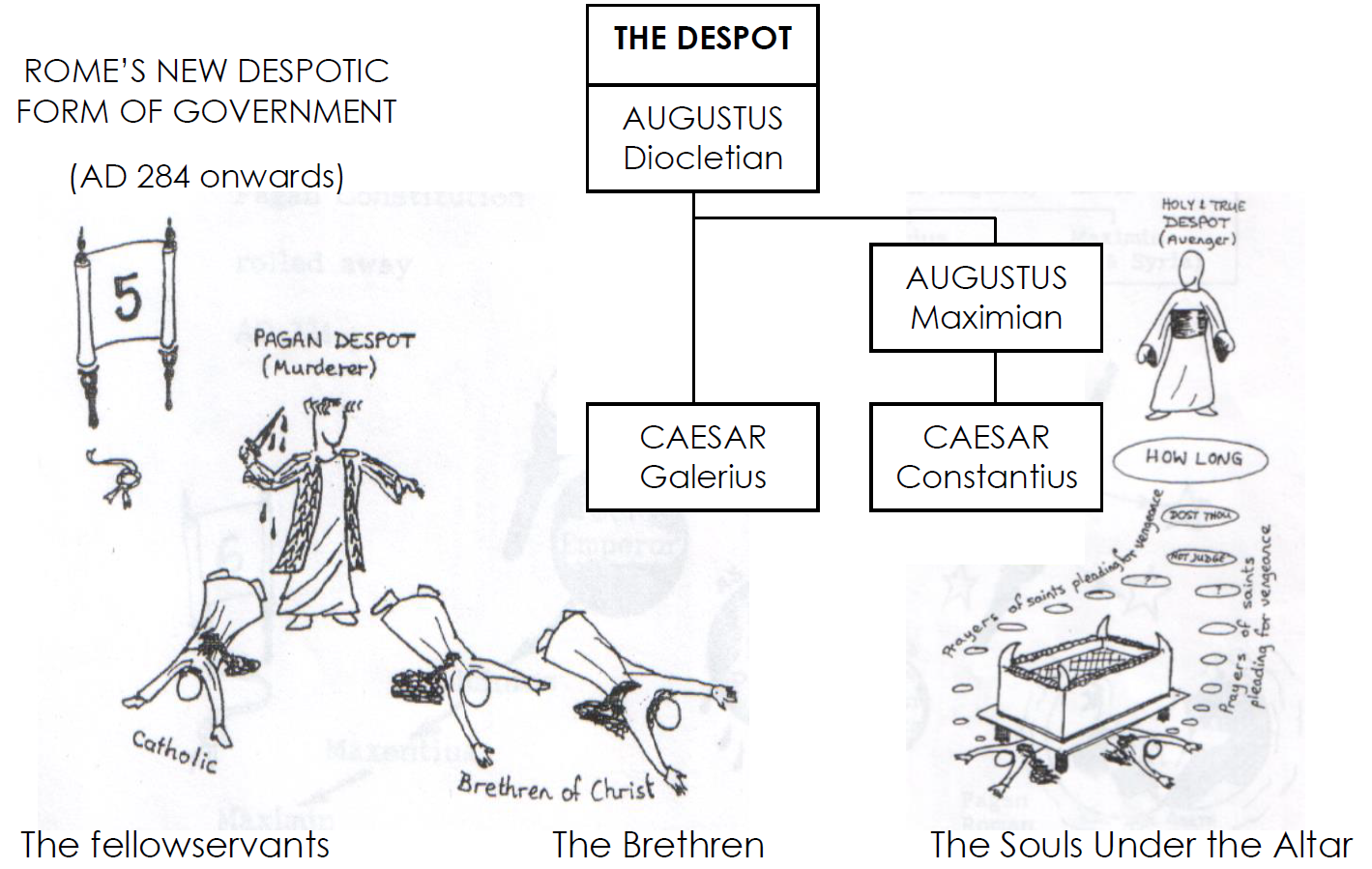
In the reign of Diocletian the form of Roman government changed, and he became the supreme ‘Despot and Emperor’. This vile despot persecuted all who opposed paganism, both true and false christians. Though a mixture of true and false, they were all fellowservants in the fight against paganism, and some of them were destined to be slain by this vile Despot because of their opposition. Though fellowservants, only a few were worthy of the name ‘Brethren of Christ’. These were symbolically connected to their altar (Christ) upon which they were willing to offer their lives. Those slain were given the promise of white garments (i.e. eternal life in the kingdom) – spoken of as though being actually bestowed simply because of the certainty of its being received. These cried unto the ‘Holy and True’ Despot, Jesus, praying that he would speedily avenge their blood on the ‘unholy and lying despot’ which thing he promised to do as soon as all destined to suffer for his holy name’s sake should have done so. This persecution ended in AD311 with Galerius’ ‘Edict of Toleration’.
The fifth seal
For 13 years the four Augusti fought each other over the issue of paganism or christianity. The final battle was fought between the two surviving Augusti in AD323, the christian Constantine defeating the pagan Licinius and becoming sole Emperor in Rome – AD324. The Pagan Empire was totally eclipsed, and a new ‘christian’ empire was formed. Rome’s pagan sun-emperor, pagan moon-priests and pagan star-administrators were cast out of government, fleeing in panic in recognition that the ‘Despot Holy and True’ was directing this day of his wrath against them. They knew that they were unable to stand before his armies. Thus the Roman world was ‘shaken to the core’ by this constitutional earthquake, and the arrowless bowman had claimed the final victory over paganism.
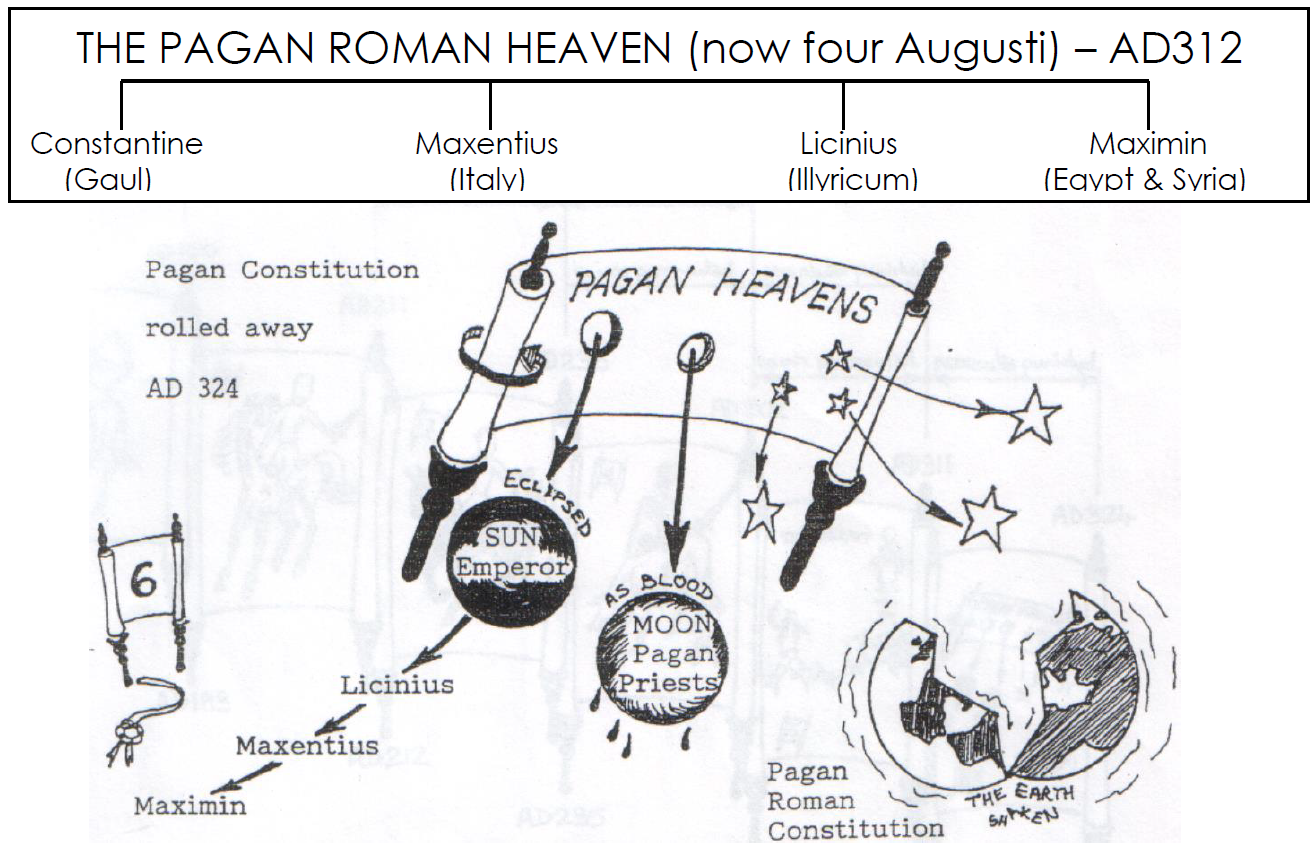
The sixth seal
There are 7 seals Revelation 5:1,5Revelation 5:1,5XWaiting for response where the opening of each one reveals elements of a time period e.g. v.1-2.Revelation 6:1-2XWaiting for response This chapter contains the opening of the first 6.
The seventh seal is different to the others however, as it contains the seven trumpets, each with their own prophecy for a time period Revelation 8:1-2.Revelation 8:1-2XWaiting for response