The woman had become the symbol of the 'Christians' although, in reality, there were two women - the chaste virgin, representing the bride of Christ, and the harlot, representing the unfaithful and apostate element. The woman is described as "a great wonder", or sign, "in (the Roman) heaven" and is therefore a similitude as perceived by the observers. All the observers would see was the anti-pagan Christian woman ascended to the throne (i.e. in heaven), be decked with the sun (i.e. now constituted the Emperor of Rome) and with the pagan priesthood (the moon) conquered under her feet, her crown of twelve stars, the crown of the Caesars, demonstrating her conquest over the Caesars. Christianity, so called, had triumphed and now reigned over the whole Roman world. This vision is the end of the vision, in Apocalyptic fashion, and is followed by the means of its accomplishment. The condition of the woman is evidence in itself that she was not the chaste virgin, or prospective bride of Christ - she was pregnant. A section of the Christians had been unfaithful to Christ, they had committed spiritual fornication and the seed styled the mystery of iniquity had been implanted in her womb. It was there to develop for the normal period of nine months, more exactly 280 symbolic days, leading her to cry out in her birth pangs, being persecuted by the Emperor in the last stages of pregnancy up to AD 313.
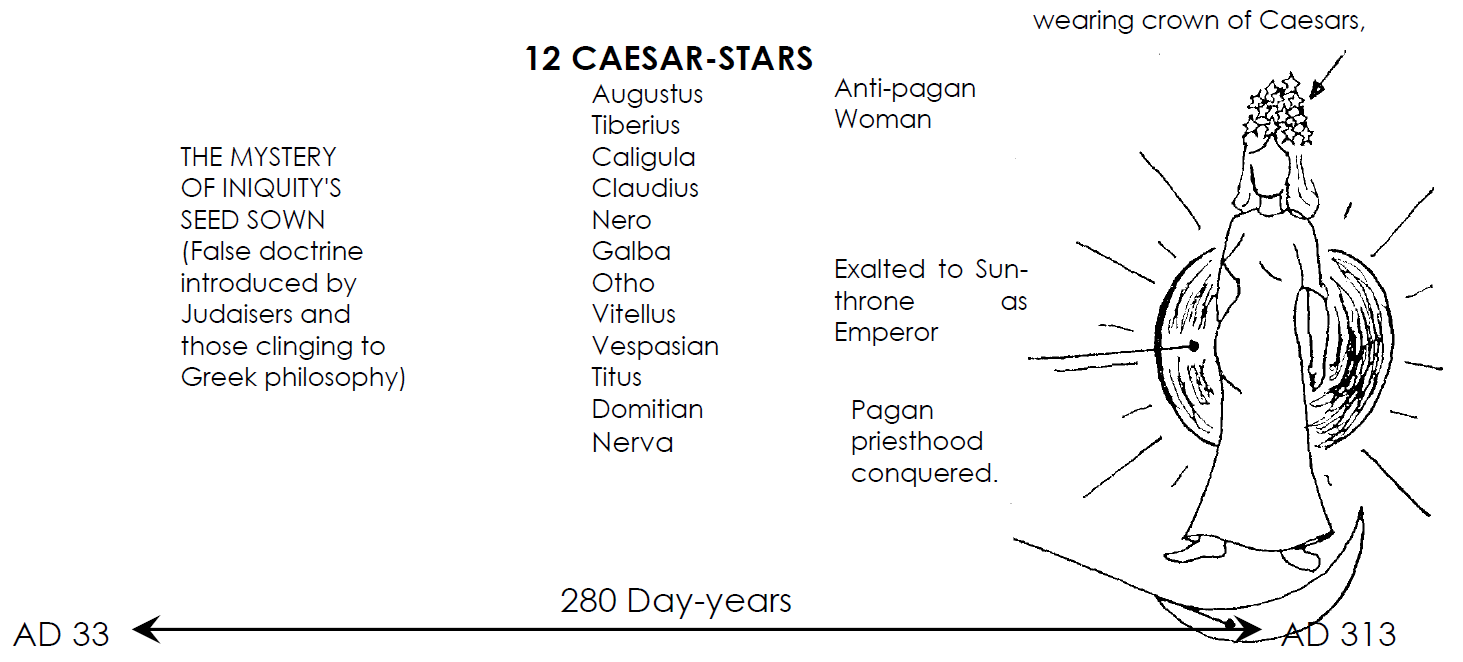
And there Appeared a Great Wonder in Heaven
The triumph of 'Christianity' over paganism was not to be without a struggle. Centuries of pagan domination would ensure that the take-over would be vigorously contested. From the days of Egypt, represented in Scripture by the dragon (or crocodile), superstition and falsehood had been the corrupting religion of the masses. Babylon took over the kingdom of men from Egypt, taking over the identity of the dragon, to be succeeded in turn by the Persians, Greeks and Romans. Pagan Rome was but the later representative of the ignorant, superstitious dragon, or crocodile. As it represented pagan Rome its appearance had adapted to the necessity. In the Roman era it was red with the blood of those saints it had killed. It also had seven heads to symbolise that its power was concentrated on the seven hills of Rome, and it was identifiable with seven forms of government (seven 'kings') from its foundation to its fall - ten horns representing the ten provinces over which each of the seven kings ruled. Thus the crowns were upon the seven heads, rather than upon the ten horns which had no independent monarch at that time. Paganism, aroused in its fury, became like the swishing tail of an angered crocodile. The Eastern Third of the Roman Empire, being devoutly pagan, was drawn to this swishing tail, and the pagan dragon stood before the 'Christian' woman ready to devour her son (the Holy Apostolic Catholic Church - so self-styled) as soon as it was born.
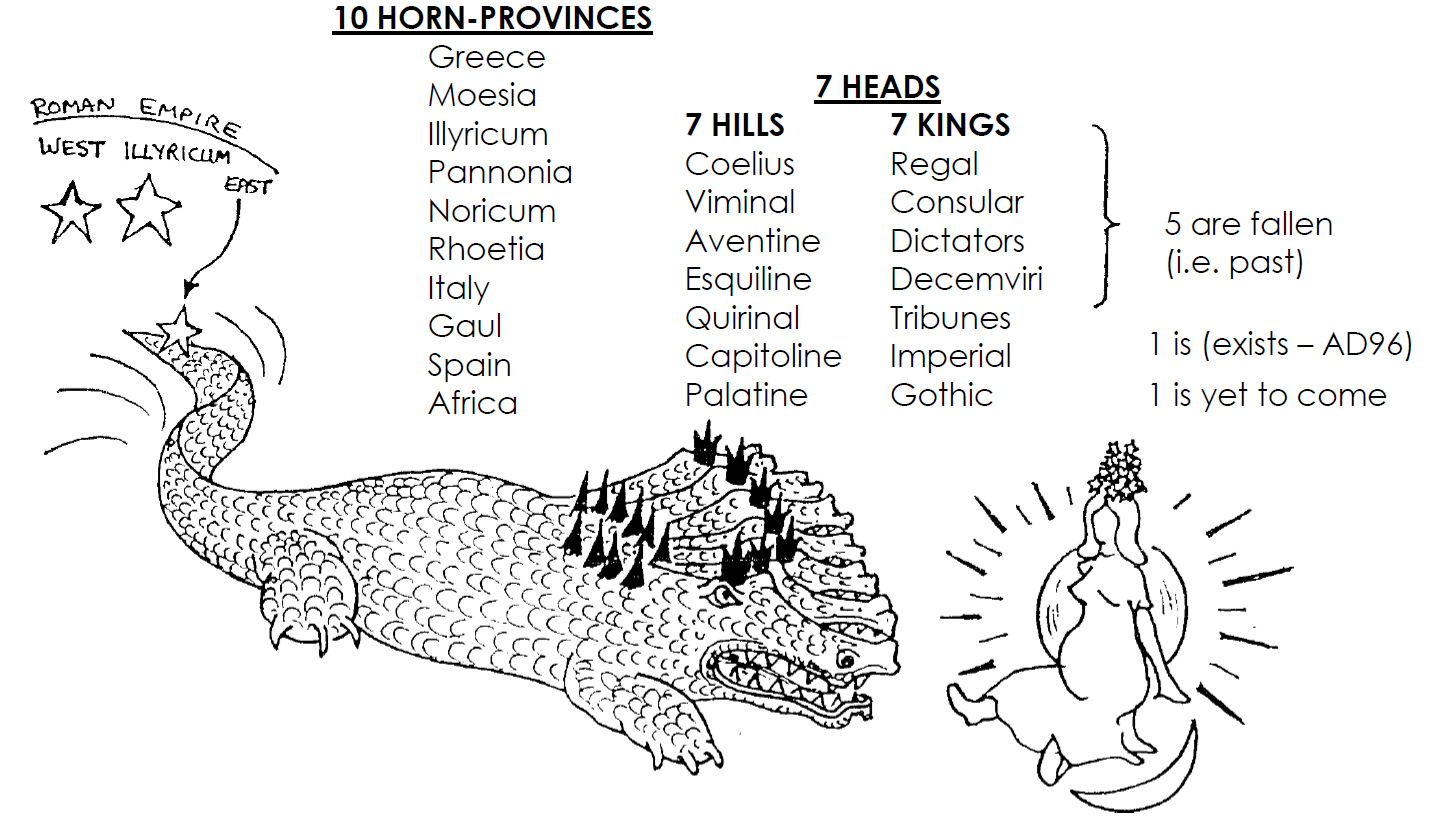
The great red (pagan) dragon
To the pagan world christendom, the developing church, was but one body, the anti-pagan body, represented here by the woman as seen in v.1.Revelation 12:1XWaiting for response To the enlightened however, there were true and false Christians, as seen in Revelation 11:3Revelation 11:3XWaiting for response & Revelation 6:11Revelation 6:11XWaiting for response – the chaste virgin, alternatively referred to as "brethren" in Revelation 6:11,Revelation 6:11XWaiting for response and the unfaithful harlot, alternatively referred to as "fellowservants" in Revelation 6:11.Revelation 6:11XWaiting for response They were united in their battle against paganism, but that was the only semblance of unity between them - just as the religions of the world today are referred to as Christianity, Islam, Buddism etc., overlooking the fact that within Christianity there are Catholics and Protestants who are violently opposed (e.g. Northern Ireland) and others who refuse to be identified with them. Islam also has its warring factions, and so on.
The developing church had the seed of apostacy which brought forth a male (man-child) which was exalted to the throne of Rome (the man-child = the man of sin 2 Thessalonians 2:32 Thessalonians 2:3XWaiting for response or the Holy Apostolic Catholic Church). The chaste virgin (true Christianity) was caused to flee into the wilderness because of the persecutions which came upon her from this usurping man-child. There she was to dwell for 1260 years, commencing in the era AD 312-315 and concluding in the era AD 1572-1575 - the period of the two witnesses described in Revelation 11:3.Revelation 11:3XWaiting for response
The ascent of Christianity was fiercely challenged by the incumbent pagan powers. In AD308 the Roman world was still divided into two halves under two Augusti, each of which was again divided into two sub-divisions under Caesars - i.e. four divisions in total. Shortly after this the two Augusti died, and Maxentius (one of the four deputies) appointed himself as Sole Emperor and planned to overthrow his co-rulers - including Constantine. In AD312 Constantine, hearing of this, invaded first and overthrew Maxentius at Verona, leaving three Caesars (now Augusti) to rule over the Roman Empire. Constantine in Western Rome was Christian, as was Licinius in Central (Illyrian) Rome, whilst Maximin in Eastern Rome was the arch defender of paganism. Constantine imposed himself as chief of the three and, in conjunction with Licinius, pronounced the Edict of Milan by which Christianity was set free in the Roman Empire. Maximin soon died, however, and Licinius pronounced himself the defender of paganism, and thus was drawn to the tail of the dragon - a move which was to see his own destruction and that of all pagans allied with him.
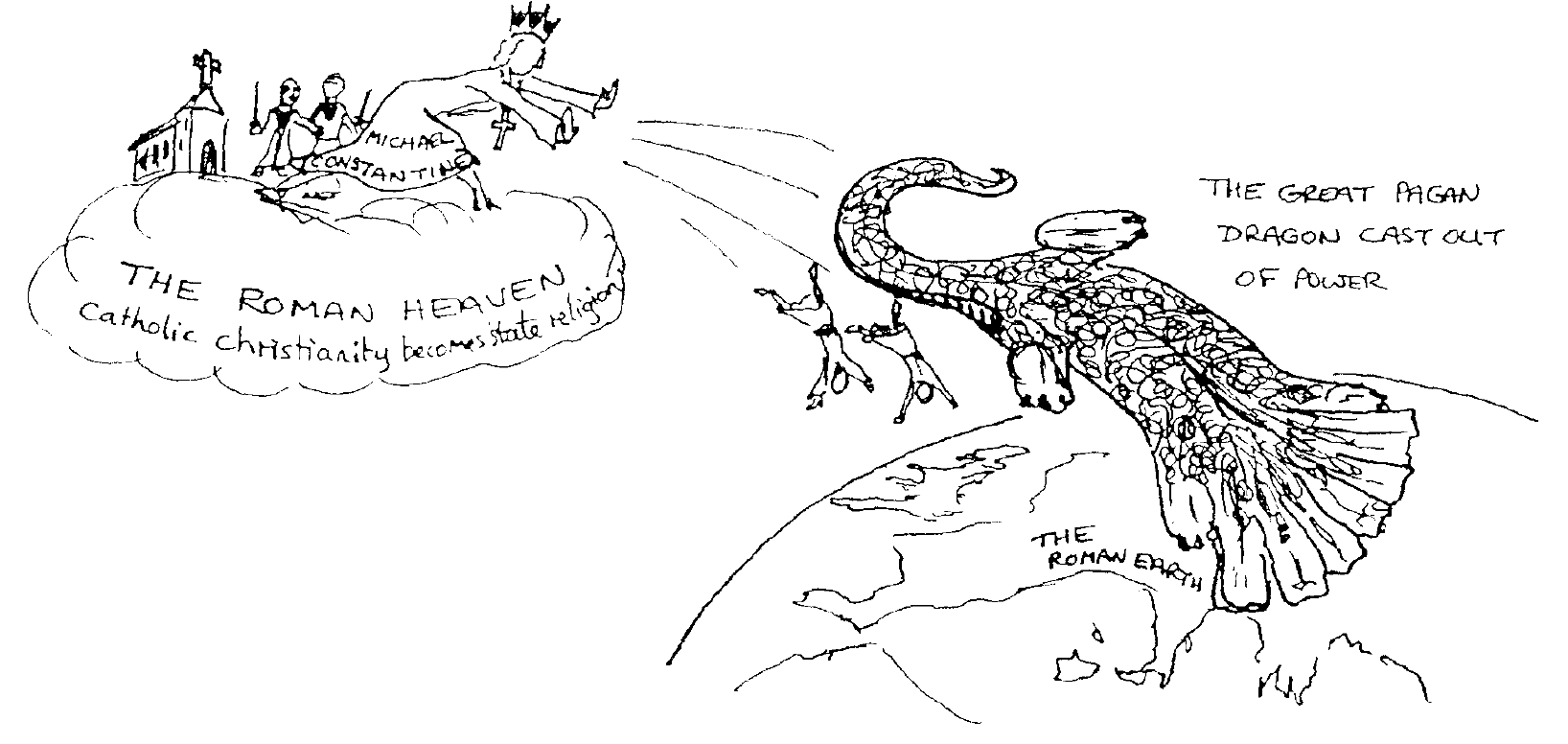
War in Heaven
The anti-pagan community, inspired by Constantine, were ecstatic at the victory over paganism. The accession of Constantine to the throne brought peace for the 'Christian' community. From the symbolism used, it is clear that the victory of Constantine and his armies (described as Michael and his angels) over the pagan dragon and his armies was used to foreshadow the future victory of Jesus and the saints over the enemies of God, and of the establishment of God's peaceful Kingdom upon the ruins of the old. The catholics were so carried away by the victory that they confused the shadow, or type, for the final reality. They had certainly received deliverance, but the Kingdom of God had not arrived – only the kingdom of their god, Constantine. History records that they celebrated the arrival of the Kingdom of God. They were now in the Laodicean state, "rich and increased with goods, and having need of nothing" (Revelation 3:17)Revelation 3:17XWaiting for response - they had no need of any other Kingdom of God. They were very satisfied, not realising that spiritually they were blind, naked and miserable. Also, the fact that they had previously been united with the (true) brethren in the purpose of denouncing and overthrowing the pagans, led those "in heaven" (i.e. the new 'Christian' rulers) to identify themselves in their victory with those souls, or "brethren" (the saints), under the altar (Revelation 6:9-11)Revelation 6:9-11XWaiting for response who had given their lives for the testimony of the Deity. This was again a false claim. The brethren had only- fought with the Testimony of God, preaching the blood of the Lamb, whereas the fellowservants, or catholics, had been happy to turn to carnal weapons for their warfare - the sword. Whilst the pagan Augustus Licinius had been relieved of Italy and Rome, he had not totally lost power - although he could see the writing was on the wall. He therefore began a vicious persecution of the Christians, determined to gain some revenge.
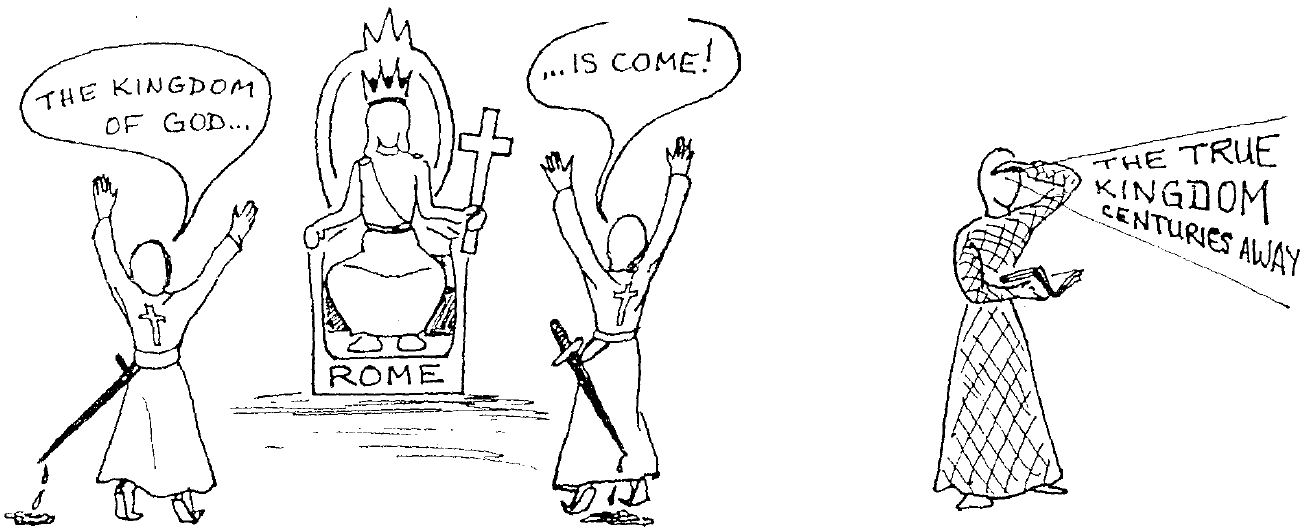
Rome becoming 'Christian' meant many rejoiced (but true believers looked for a future rejoicing)
Soon Constantine declared Rome a Christian empire, making the Catholic apostacy the new state religion. The saints protested that it was false Christianity – a continuation of pagan practices under christianised names - and that the Emperor was really still a pagan. This change was foretold by a change of symbol from "the great red dragon" to "the serpent" v.13-14.Revelation 12:13-14XWaiting for response Constantine was just the dragon in disguise, and resented being exposed by the testimony of the sackcloth witnesses. Soon he began to persecute them, hoping to 'drown' them in a flood of legislation, banning all non-catholic religious meetings and assemblies. On account of this the saints were forced to flee to North Africa and Northern Europe, the two extremes of the Roman Empire where people were more sympathetic to their cause. Here they found sympathisers who, though atheistic, were incensed at the Emperor's infringement of human liberties, whether religious or not. Fighting for freedom of speech and human liberties, these people (symbolised as "the earth") forced the restrictive legislation to be withdrawn. Thus the earth symbolically opened its mouth and swallowed up the hostile flood of legislation, preserving the liberty of the faithful virgin woman. So the woman was provided with a place by God, in which she could dwell during the period of three times and an half (three cycles and an half, each of 360 years duration), or 1260 years. The period is that of the sackcloth witnessing of Revelation 11:3,Revelation 11:3XWaiting for response commencing with the Edict of Milan in AD312-313 and concluding with the slaughter of the Huguenots in France, on 24th August AD1572.
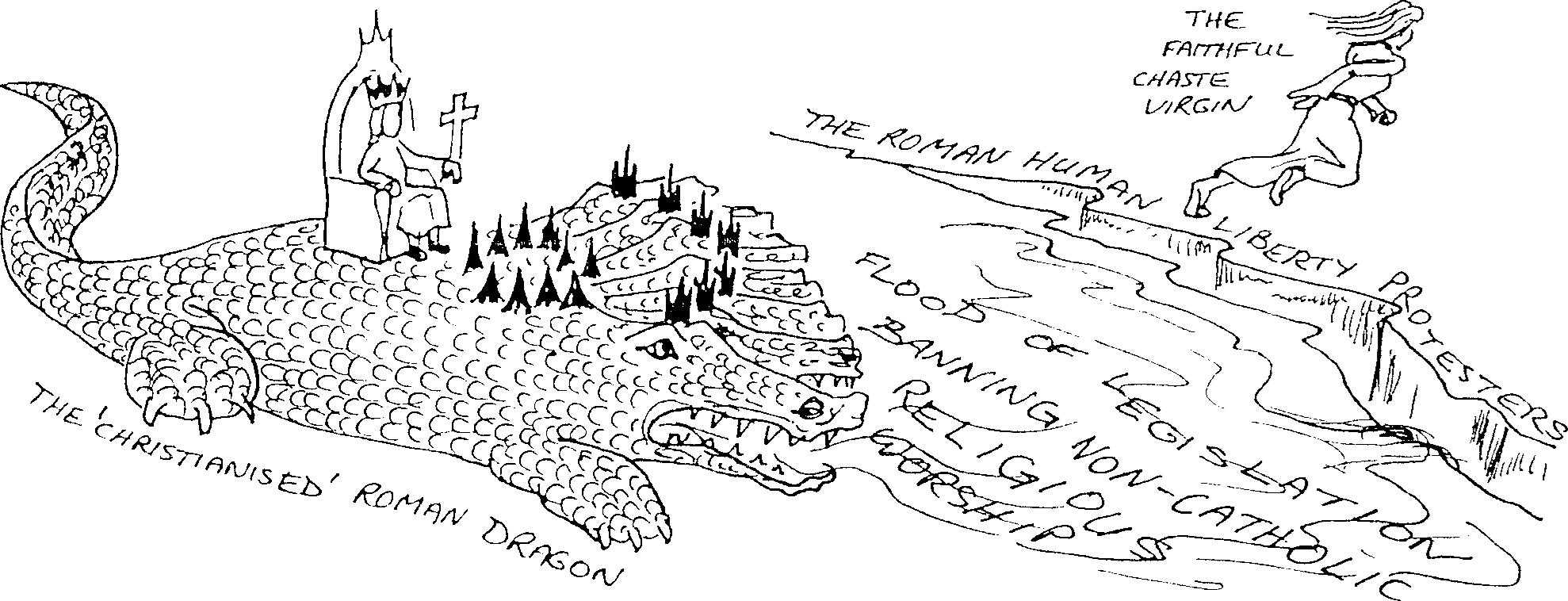
The false Christians now revealed as pagan (ie the dragon) try to remove the true Christians
The twelfth chapter of the Book of Revelation takes us back in time to consider how the Roman Apostate church had its beginnings and how it took over the persecuting role of the pagan Roman religion.
In the first six verses of the twelfth chapter of the Book of Revelation, there is a prophecy of the warfare which developed between the old established paganism of Rome and the developing Christian church - represented by a pregnant woman. The woman was perceived by the Roman people to be one Christian religion whereas, in truth, there was a true Christian religion - the chaste virgin, representing the saints - and a false Christian religion. The developing church was inseminated with the seed of apostacy or falsehood and it brought forth a male who was given power over the Roman empire.